

Paramedical Tattooing
Surgery, an accident, or an illness can visibly alter the body. This can feel unfamiliar, even long after medical treatment is complete. At such times, many people don’t desire “perfection” but rather a sense of wholeness and familiarity.
Paramedical tattooing can address this precisely. It is not a medical procedure, but an aesthetic reconstruction aimed at helping you feel more comfortable in your own body again.
Our Medical Tattooing Services:
3D Nipple Reconstruction
What is it?
3D nipple reconstruction involves visually realistic pigmentation of a nipple. Through light, shadow, and subtle color gradients, the illusion of depth and texture is created, making the nipple appear three-dimensional even though it is flat. Shape, size, and shade are individually discussed with you beforehand and tailored to your body.
For whom?
This tattooing is for women and men who have lost their nipples due to surgery, for example, after breast cancer, prophylactic mastectomy, or other medical procedures.
What does it achieve?
3D nipple reconstructions can help individuals feel more complete again, not just physically but also emotionally. They allow one to view their own body without the feeling of loss and to more easily allow intimacy again.
Why specialized?
In many cases, medical procedures only involve the pigmentation of a simple, pink circle. This solution serves a functional purpose but often does not consider fine details or individual aesthetics.
Professional 3D nipple pigmentation goes beyond this. It is part of the color reconstruction and should be performed by specialized tattoo artists. After surgery, color reconstruction is a distinct, specialized field.
3D Nipple Reconstruction
What is it?
3D nipple reconstruction involves visually realistic pigmentation of a nipple. Through light, shadow, and subtle color gradients, the illusion of depth and texture is created, making the nipple appear three-dimensional even though it is flat. Shape, size, and shade are individually discussed with you beforehand and tailored to your body.
For whom?
This tattooing is for women and men who have lost their nipples due to surgery, for example, after breast cancer, prophylactic mastectomy, or other medical procedures.
What does it achieve?
3D nipple reconstructions can help individuals feel more complete again, not just physically but also emotionally. They allow one to view their own body without the feeling of loss and to more easily allow intimacy again.
Why specialized?
In many cases, medical procedures only involve the pigmentation of a simple, pink circle. This solution serves a functional purpose but often does not consider fine details or individual aesthetics.
Professional 3D nipple pigmentation goes beyond this. It is part of the color reconstruction and should be performed by specialized tattoo artists. After surgery, color reconstruction is a distinct, specialized field.
NipBlush – Cosmetic Nipple Pigmentation
What is it?
NipBlush is a cosmetic nipple pigmentation that balances and refines the color of the areola. The goal is a harmonious, natural-looking appearance of the nipple. The shade and intensity are individually adjusted to your skin and breast.
For whom?
NipBlush is suitable for women whose areola pigmentation has changed, for example, due to natural processes, scars, or after breast surgeries such as breast augmentation, breast reduction, or other surgical procedures.
What does it achieve?
NipBlush pigmentation can help to balance irregularities and alter the appearance of the nipple. Many find the result empowering for their body image and aesthetic well-being.
NipBlush – Cosmetic Nipple Pigmentation
What is it?
NipBlush is a cosmetic nipple pigmentation that balances and refines the color of the areola. The goal is a harmonious, natural-looking appearance of the nipple. The shade and intensity are individually adjusted to your skin and breast.
For whom?
NipBlush is suitable for women whose areola pigmentation has changed, for example, due to natural processes, scars, or after breast surgeries such as breast augmentation, breast reduction, or other surgical procedures.
What does it achieve?
NipBlush pigmentation can help to balance irregularities and alter the appearance of the nipple. Many find the result empowering for their body image and aesthetic well-being.
Scar & Stretch Mark Camouflage
What is important to understand?
Scars and stretch marks differ visually from healthy skin. They are often lighter, firmer, or irregularly structured and have a different skin texture. Stretch marks are not superficial changes but scars in deeper skin layers.
Structure before Color
Before considering color camouflage, the skin structure must be taken into account. Raised, hardened, or very uneven scars cannot be effectively pigmented, as color cannot compensate for structure.
To improve skin structure, we work with scar needling (MCA). Micro-fine needle punctures stimulate skin regeneration. Blood circulation and the production of collagen, elastin, and melanin are activated. This can smooth and soften the scar over time.
Laser treatments can also contribute to structural improvement. We do not offer these ourselves but recommend them before pigmentation.
When is camouflage appropriate?
Color camouflage is only an option when the scar is flat, stably healed, and structurally calm. The goal of camouflage is to match the color of light scars to the surrounding skin, not to change the skin structure.
It is also important that the skin tone remains as even as possible. Strong sun exposure can cause pigmented areas to stand out significantly from the rest of the skin tone.
Who is this treatment suitable for?
Scar and stretch mark camouflage is suitable for people with fully healed, flatter scars or stretch marks where the skin structure has already been improved or is naturally calm.
Our Approach
If you are interested in scar or stretch mark camouflage, we recommend an initial consultation. During this, we will jointly assess whether structural improvement through needling is appropriate or if color camouflage can be considered directly.
Before larger areas are pigmented, we always work with a small test patch. This allows us to see how your skin reacts and how the pigment heals. Only then do we jointly decide on the further course of action.
The right timing is also important. Only skin areas that are not permanently exposed to strong sunlight are pigmented, or preferably during the winter months when the natural skin tone is as unaffected as possible. This ensures that the result remains consistent in the long term.
Scar & Stretch Mark Camouflage
What is important to understand?
Scars and stretch marks differ visually from healthy skin. They are often lighter, firmer, or irregularly structured and have a different skin texture. Stretch marks are not superficial changes but scars in deeper skin layers.
Structure before Color
Before considering color camouflage, the skin structure must be taken into account. Raised, hardened, or very uneven scars cannot be effectively pigmented, as color cannot compensate for structure.
To improve skin structure, we work with scar needling (MCA). Micro-fine needle punctures stimulate skin regeneration. Blood circulation and the production of collagen, elastin, and melanin are activated. This can smooth and soften the scar over time.
Laser treatments can also contribute to structural improvement. We do not offer these ourselves but recommend them before pigmentation.
When is camouflage appropriate?
Color camouflage is only an option when the scar is flat, stably healed, and structurally calm. The goal of camouflage is to match the color of light scars to the surrounding skin, not to change the skin structure.
It is also important that the skin tone remains as even as possible. Strong sun exposure can cause pigmented areas to stand out significantly from the rest of the skin tone.
Who is this treatment suitable for?
Scar and stretch mark camouflage is suitable for people with fully healed, flatter scars or stretch marks where the skin structure has already been improved or is naturally calm.
Our Approach
If you are interested in scar or stretch mark camouflage, we recommend an initial consultation. During this, we will jointly assess whether structural improvement through needling is appropriate or if color camouflage can be considered directly.
Before larger areas are pigmented, we always work with a small test patch. This allows us to see how your skin reacts and how the pigment heals. Only then do we jointly decide on the further course of action.
The right timing is also important. Only skin areas that are not permanently exposed to strong sunlight are pigmented, or preferably during the winter months when the natural skin tone is as unaffected as possible. This ensures that the result remains consistent in the long term.
Radiation Mark Camouflage or Removal
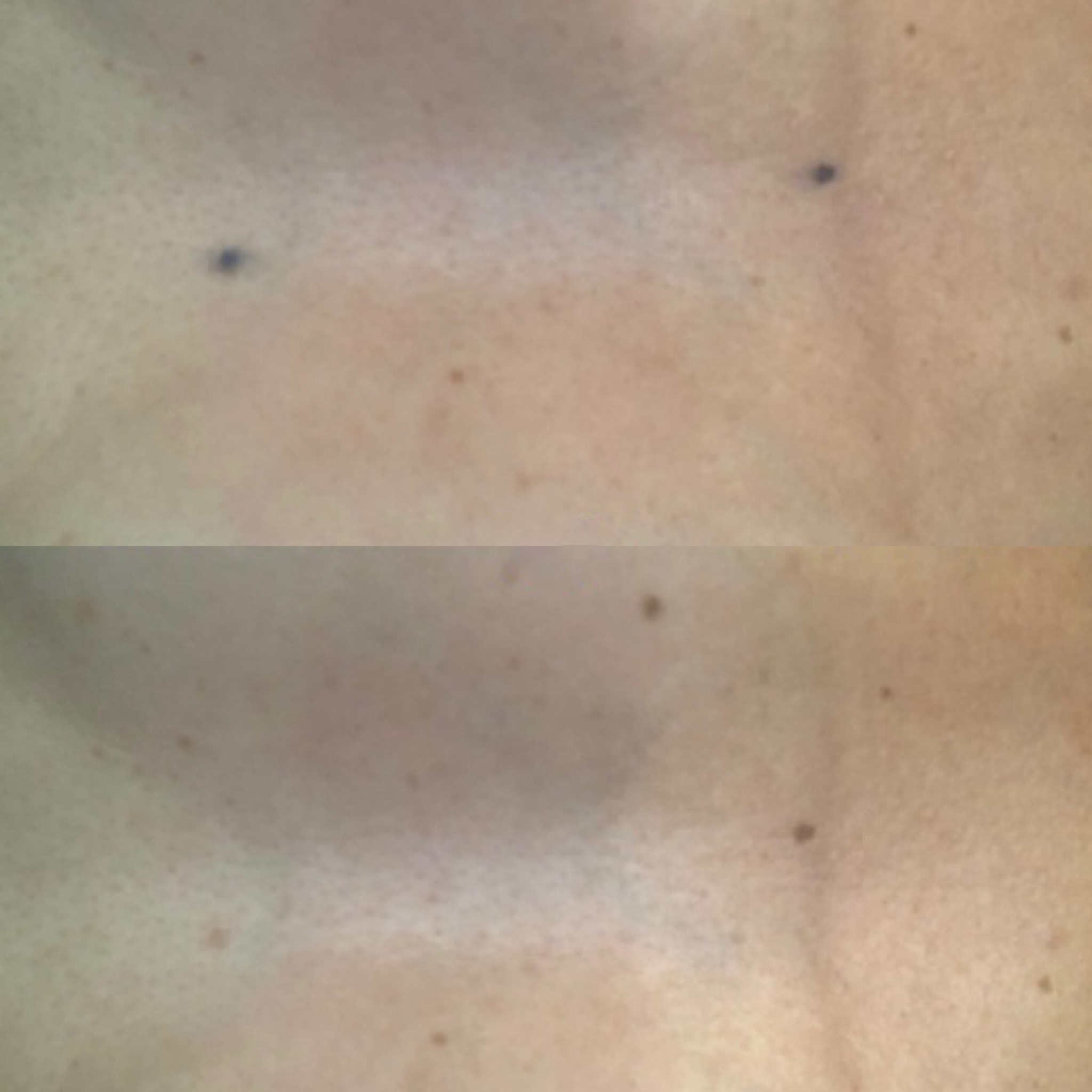
Radiation mark camouflage involves either covering existing radiation marks with color-matched micropigmentation or, if necessary, removing them with a pigment remover. The goal is to make the marks visually less noticeable or to dissolve them completely.
For many affected individuals, radiation marks are a permanent reminder of a stressful time. To help you externally conclude this phase, we offer camouflage or removal of radiation marks as a complimentary treatment.
Alternatively, radiation marks can be artistically integrated, for example, by transforming them into fine freckles. We will discuss which option makes sense for you individually and at your leisure.
Radiation Mark Camouflage or Removal
Radiation mark camouflage involves either covering existing radiation marks with color-matched micropigmentation or, if necessary, removing them with a pigment remover. The goal is to make the marks visually less noticeable or to dissolve them completely.
For many affected individuals, radiation marks are a permanent reminder of a stressful time. To help you externally conclude this phase, we offer camouflage or removal of radiation marks as a complimentary treatment.
Alternatively, radiation marks can be artistically integrated, for example, by transforming them into fine freckles. We will discuss which option makes sense for you individually and at your leisure.
Permanent Makeup after Illness, Accidents, or Hair Loss
Permanent makeup can support individuals who have experienced facial changes due to illness or medication-induced hair loss. Especially after chemotherapy or with alopecia, permanent makeup can help to optically reconstruct eyebrows and eyelashes, giving the face more expression and balance.
Permanent makeup can also be effectively used in the lip area. For cleft lip and palate, irregularities in shape and color can be visually balanced. Through precise shape building, especially in the Cupid’s bow area, and individually adapted color selection, the appearance of the lips can be harmonized. Similarly, scars in the mouth area, for example after accidents or surgical procedures, can be carefully concealed.
For a stable and consistent result, one to three treatments are usually required. We will clarify which technique is appropriate and what procedure is suitable individually during a consultation.
Permanent Makeup after Illness, Accidents, or Hair Loss
Permanent makeup can support individuals who have experienced facial changes due to illness or medication-induced hair loss. Especially after chemotherapy or with alopecia, permanent makeup can help to optically reconstruct eyebrows and eyelashes, giving the face more expression and balance.
Permanent makeup can also be effectively used in the lip area. For cleft lip and palate, irregularities in shape and color can be visually balanced. Through precise shape building, especially in the Cupid’s bow area, and individually adapted color selection, the appearance of the lips can be harmonized. Similarly, scars in the mouth area, for example after accidents or surgical procedures, can be carefully concealed.
For a stable and consistent result, one to three treatments are usually required. We will clarify which technique is appropriate and what procedure is suitable individually during a consultation.

Call for Donations
TATA FOUNDATION
My two trainers at the Areola Training Academy specialize in providing first-class training in nipple tattooing while supporting free nipple pigmentation. Their goal is to equip students with the necessary knowledge and skills to become outstanding artists in this field. They place great emphasis on fostering their students’ creative expression and helping them continuously develop their craft.
The Tata Foundation, a non-profit organization, raises funds to cover the costs of products, equipment, and labor for creating life-changing nipple tattoos. Once a year, the team of artists from the Tata Foundation organizes a fundraiser to raise more awareness for this important cause. If you would like to support the Tata Foundation, please click here.